The race to build a functional space internet has taken a revolutionary turn with the rapid advancement of inter-satellite laser communication technology. What was once confined to science fiction is now becoming operational reality as aerospace companies and national space agencies demonstrate increasingly sophisticated systems for laser-based data transmission between orbiting spacecraft.
The fundamental shift from radio frequency to optical communication represents one of the most significant breakthroughs in space infrastructure development. Traditional satellite networks rely on radio waves for data transfer, but these systems face inherent limitations in bandwidth and speed. Laser communications, using infrared light rather than radio waves, can achieve data rates up to 100 times faster while using smaller, more efficient hardware. This technological leap comes at a critical moment when the demand for space-based data services is growing exponentially.
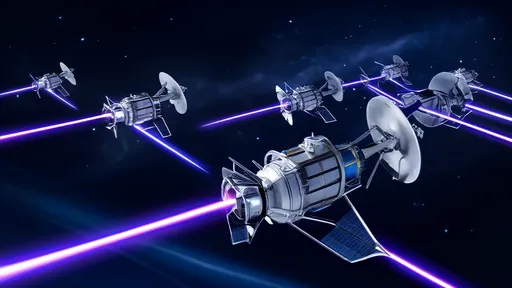
Several pioneering missions have proven the viability of laser links in space. The European Space Agency's (ESA) Sentinel-1 satellites have successfully maintained laser connections while moving at orbital velocities. Meanwhile, private sector players like SpaceX with their Starlink constellation and Telesat with Lightspeed are implementing laser inter-satellite links as core components of their next-generation networks. These systems create what engineers describe as a "web of light" in low Earth orbit, with photons carrying data between nodes at speeds approaching terrestrial fiber optics.
The technical challenges of maintaining precise laser alignment between moving satellites cannot be overstated. Spacecraft traveling at 7.8 km/s must establish and maintain optical connections where the beam width measures mere microradians. Advanced pointing, acquisition, and tracking systems use ultra-fine steering mirrors and sensitive detectors to compensate for the relative motion between satellites. Thermal stability becomes paramount as even minute temperature fluctuations can affect optical components. Engineers have developed sophisticated compensation algorithms that allow these systems to maintain connections despite the harsh conditions of space.
One of the most compelling advantages of laser-based space networks is the reduced latency compared to ground-based infrastructure. Data traveling between continents via undersea cables must follow the Earth's curvature, adding milliseconds to transmission times. A space-based optical network can route information more directly through orbital pathways. For financial transactions, cloud computing, and other latency-sensitive applications, this difference translates to competitive advantages worth billions. The military significance is equally profound, enabling real-time data sharing between surveillance satellites, command centers, and frontline units.
The environmental impact of space internet systems has become a growing concern, and laser communications offer notable improvements in this regard. Optical terminals consume less power than comparable radio systems while delivering superior performance. This reduced power requirement translates to smaller solar panels and more efficient satellite designs. Additionally, the highly directional nature of laser beams minimizes interference with astronomical observations—a significant issue with traditional satellite radio transmissions that spread across wide frequency bands.
Standardization efforts are underway to ensure interoperability between different operators' laser communication systems. The Consultative Committee for Space Data Systems (CCSDS) has published optical communication specifications that are being adopted by both government and commercial entities. This standardization is crucial for creating a cohesive space internet rather than isolated proprietary networks. The ability for satellites from different constellations to establish temporary laser links could dramatically increase the resilience and capacity of orbital communications infrastructure.
Looking ahead, the next frontier involves extending these laser networks beyond Earth orbit. NASA's Lunar Laser Communication Demonstration achieved record-breaking data rates between the Moon and Earth, proving that interplanetary internet is within reach. Mars orbiters could form the backbone of a solar system internet, with laser links maintaining constant connectivity between Earth, Mars, and eventually other destinations. The same technology enabling video calls between continents today may one day support live feeds from astronauts on Mars.
The economic implications of space laser communications are profound. Analysts project the market for optical inter-satellite links will grow tenfold within the decade as constellations expand and technology matures. This growth is driving innovation in component manufacturing, with companies developing space-qualified lasers, detectors, and optical assemblies that can withstand years of radiation and thermal cycling. The supply chain for these systems is becoming increasingly sophisticated, mirroring the evolution of the semiconductor industry in previous decades.
While the technology shows tremendous promise, significant hurdles remain before space-based laser networks achieve their full potential. Space weather events like solar flares can temporarily disrupt optical links, requiring robust error correction protocols. The long-term reliability of these systems in the harsh space environment continues to be evaluated through ongoing missions. Furthermore, the regulatory framework for laser frequency allocation and space traffic management must evolve to accommodate thousands of optical links crisscrossing orbital planes.
The development of space internet through laser communication represents one of the most ambitious infrastructure projects in human history. Unlike terrestrial networks constrained by geography and politics, this orbital web has the potential to become a truly global—and eventually interplanetary—communications system. As the technology transitions from experimental demonstrations to operational deployments, it may well redefine how humanity stays connected across the vast distances of space.

By /Jul 22, 2025

By /Jul 22, 2025

By /Jul 22, 2025

By /Jul 22, 2025

By /Jul 22, 2025

By /Jul 22, 2025

By /Jul 22, 2025

By /Jul 22, 2025

By /Jul 22, 2025

By /Jul 22, 2025

By /Jul 22, 2025
By /Jul 22, 2025
By /Jul 22, 2025

By /Jul 22, 2025

By /Jul 22, 2025
By /Jul 22, 2025

By /Jul 22, 2025

By /Jul 22, 2025
