Virtual Disassembly: DPU Chip Architecture

Jul 22, 2025 By

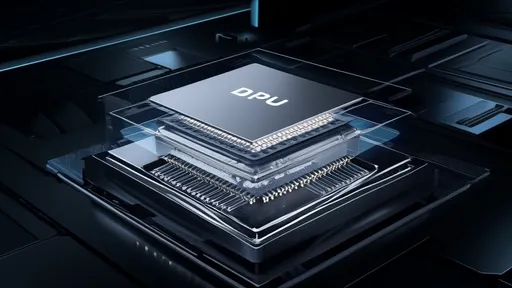
The semiconductor industry is undergoing a paradigm shift with the emergence of Data Processing Units (DPUs) as specialized accelerators for modern data-centric workloads. Unlike traditional CPUs and GPUs, DPUs are designed to offload and accelerate infrastructure tasks like networking, storage, and security, enabling more efficient data center operations. A virtual teardown of DPU architectures reveals fascinating insights into how these chips are redefining the boundaries of computational efficiency.

At the heart of every DPU lies a heterogeneous architecture that combines multiple processing elements tailored for specific functions. Arm-based multicore CPUs often serve as the control plane, managing orchestration and coordination tasks. These cores are complemented by high-performance packet processing engines that handle network traffic at line rates, typically implemented through custom hardware or programmable accelerators. The storage subsystem frequently incorporates dedicated encryption/decryption blocks and DMA engines to enable secure, low-latency data movement.

The most intriguing aspect of DPU design emerges in the network interface layer, where cutting-edge implementations integrate 100-400GbE controllers directly onto the die. This tight coupling of network functionality eliminates traditional bottlenecks associated with discrete NICs. Some architectures go further by implementing smart NIC capabilities through programmable pipelines that can parse, modify, and forward packets without CPU intervention. The inclusion of match-action engines and statistical multiplexers allows for sophisticated traffic management at wire speed.

Memory subsystems in DPUs showcase equally innovative approaches. Most designs implement a multi-tiered memory hierarchy combining large DDR controllers for bulk data with low-latency SRAM or HBM for acceleration structures. The memory controllers often feature quality-of-service (QoS) mechanisms to prioritize critical traffic flows. Some architectures even incorporate near-memory processing elements that can perform basic operations directly in memory controllers, further reducing data movement.

Power efficiency has become a defining characteristic of DPU architectures. Through advanced power gating and dynamic voltage/frequency scaling, these chips maintain exceptional performance-per-watt metrics. The thermal design power (TDP) of most DPUs remains surprisingly low given their capabilities, typically ranging between 25-75W. This efficiency stems from the extensive use of domain-specific accelerators that avoid the overhead of general-purpose computation.

The software ecosystem surrounding DPUs reveals another layer of innovation. Unlike traditional processors that rely on standard operating systems, DPUs typically run lightweight real-time kernels or bare-metal applications tailored for specific workloads. The toolchains for these devices increasingly support high-level programming models that abstract the underlying hardware complexity, allowing developers to focus on functionality rather than low-level optimization.

Security features in DPU architectures have evolved to address modern threats. Most designs incorporate hardware root of trust modules, secure boot mechanisms, and memory encryption engines as standard features. Some implementations go further by including runtime attestation capabilities that continuously verify the integrity of both code and data. These security measures are particularly crucial as DPUs often handle sensitive infrastructure operations in multi-tenant environments.

Looking ahead, DPU architectures continue to evolve at a rapid pace. The next generation of designs promises even tighter integration of AI acceleration blocks for intelligent network processing and optical interface options for higher bandwidth connectivity. As hyperscalers and cloud providers increasingly adopt DPUs as standard infrastructure components, these specialized processors are poised to redefine data center economics and capabilities for years to come.

Recommend Posts
IT

Prioritization Model for Technical Debt Repayment

By /Jul 22, 2025

In the fast-paced world of software development, technical debt has become an inevitable byproduct of rapid innovation and tight deadlines. While some degree of technical debt might be necessary to meet business objectives, allowing it to accumulate unchecked can lead to severe consequences, including system failures, security vulnerabilities, and decreased developer productivity. To address this challenge, organizations are increasingly turning to Technical Debt Repayment Priority Models—structured frameworks that help teams identify, assess, and prioritize debt repayment efforts effectively.
IT

Developer Burnout Indicator

By /Jul 22, 2025

In the fast-paced world of software development, burnout has emerged as a silent productivity killer that often goes unnoticed until it's too late. Unlike physical injuries that manifest visibly, developer burnout creeps in gradually through subtle behavioral changes and performance patterns. Tech leaders who learn to recognize these early warning signs can implement preventive measures before their teams reach critical exhaustion levels.
IT

Domestication Map of Semiconductor Manufacturing Equipment

By /Jul 22, 2025

The global semiconductor industry has entered an era of unprecedented geopolitical tension and supply chain restructuring. Against this backdrop, China's ambitious drive to develop domestic semiconductor manufacturing capabilities has taken on new urgency. At the heart of this effort lies the critical challenge of equipment localization - reducing dependence on foreign suppliers for the sophisticated tools needed to produce advanced chips.
IT

Maturity of Zero Trust in Technology Enterprises

By /Jul 22, 2025

The concept of Zero Trust has evolved from buzzword to business imperative in today's hyper-connected digital landscape. As cyber threats grow more sophisticated, technology enterprises are increasingly adopting Zero Trust architectures - but not all implementations are created equal. The maturity of a company's Zero Trust framework often determines its effectiveness in mitigating modern security risks.
IT

Game-based Learning of LLVM Compiler

By /Jul 22, 2025

The world of compiler development has long been considered an elite domain reserved for computer science academics and seasoned software engineers. Yet a quiet revolution is brewing as innovative educators and technologists experiment with gamification techniques to make LLVM - one of the most sophisticated compiler frameworks - accessible to curious learners at all skill levels.
IT

Global Computing Power Futures Trading Model

By /Jul 22, 2025

The global computing power futures trading model has emerged as a revolutionary financial instrument, bridging the gap between technology and traditional commodity markets. As the demand for computational resources surges across industries—from artificial intelligence to blockchain—investors and corporations are increasingly turning to futures contracts to hedge against price volatility and secure future capacity. This innovative market reflects the growing recognition of computing power as a critical, tradable asset class in the digital economy.
IT

Animation Analysis of MIMO Beamforming

By /Jul 22, 2025

The world of wireless communication has witnessed a paradigm shift with the advent of Multiple Input Multiple Output (MIMO) technology. Among its many applications, MIMO beamforming stands out as a game-changer, enabling faster data rates, improved signal quality, and enhanced network capacity. This technique, often visualized in animations for better understanding, leverages multiple antennas to direct signals precisely toward intended receivers while minimizing interference. The result is a more efficient and reliable wireless experience, whether in 5G networks, Wi-Fi systems, or even satellite communications.
IT

Virtual Disassembly: DPU Chip Architecture

By /Jul 22, 2025

The semiconductor industry is undergoing a paradigm shift with the emergence of Data Processing Units (DPUs) as specialized accelerators for modern data-centric workloads. Unlike traditional CPUs and GPUs, DPUs are designed to offload and accelerate infrastructure tasks like networking, storage, and security, enabling more efficient data center operations. A virtual teardown of DPU architectures reveals fascinating insights into how these chips are redefining the boundaries of computational efficiency.
IT

Comic Illustration of CAP Theorem in Practice

By /Jul 22, 2025

The CAP theorem remains one of the most fundamental yet frequently misunderstood concepts in distributed systems. While technical papers and textbooks explain the theory, many developers still struggle to grasp its practical implications. This is where visual explanations - particularly comic-style illustrations - can bridge the understanding gap better than equations or architectural diagrams ever could.
IT

HTTPS Hijacking Attack and Defense Experiment

By /Jul 22, 2025

The ongoing battle between cybersecurity professionals and malicious actors has reached a critical juncture with the rise of HTTPS interception and hijacking attacks. As more organizations transition to encrypted communication, attackers have adapted their techniques to exploit vulnerabilities in the very protocols designed to protect users. Recent interactive experiments have shed light on both the sophistication of these attacks and the innovative defenses being developed to counter them.
IT

Programmable Metamaterials Control Precision

By /Jul 22, 2025

The field of programmable metamaterials has witnessed groundbreaking advancements in recent years, particularly in the realm of precision control. These engineered materials, designed to exhibit properties not found in nature, are now being fine-tuned with unprecedented accuracy, opening doors to applications ranging from adaptive optics to next-generation wireless communications.
IT

Efficiency of Environmental RF Energy Harvesting

By /Jul 22, 2025

In an era where wireless connectivity dominates, the concept of harvesting ambient radio frequency (RF) energy has emerged as a promising solution to power low-energy devices sustainably. Unlike traditional energy sources, RF energy harvesting leverages the omnipresent electromagnetic waves from Wi-Fi, cellular networks, and broadcast signals to generate electricity. This technology holds immense potential for powering IoT devices, wearables, and remote sensors without relying on batteries or wired connections. However, the efficiency of RF energy harvesting remains a critical challenge, as the ambient RF signals are often weak and sporadic.
IT

Space Internet Intersatellite Laser Communication

By /Jul 22, 2025

The race to build a functional space internet has taken a revolutionary turn with the rapid advancement of inter-satellite laser communication technology. What was once confined to science fiction is now becoming operational reality as aerospace companies and national space agencies demonstrate increasingly sophisticated systems for laser-based data transmission between orbiting spacecraft.
IT

Optimization of Pulse Encoding for Brain-Inspired Chip Impulses

By /Jul 22, 2025

The field of neuromorphic computing has taken a significant leap forward with recent breakthroughs in pulse coding optimization for brain-inspired chips. As researchers strive to bridge the gap between biological neural networks and artificial intelligence systems, the refinement of pulse-based information encoding has emerged as a critical frontier. These developments promise to revolutionize how we process information in energy-efficient computing architectures.
IT

Deepfake Detection Federated Learning

By /Jul 22, 2025

The rapid advancement of deepfake technology has raised significant concerns across industries, governments, and civil society. As synthetic media becomes increasingly sophisticated, the need for robust detection mechanisms has never been more urgent. In this landscape, federated learning emerges as a promising approach to combat deepfakes while addressing critical privacy concerns. This article explores how this decentralized machine learning technique is reshaping the fight against manipulated media.
IT

Breakthrough in Molecular Computing Gate Circuit Design

By /Jul 22, 2025

In a landmark development that could redefine the future of electronics, researchers have achieved a significant breakthrough in molecular-scale circuit design. This advancement promises to push the boundaries of computing power while dramatically reducing energy consumption and physical footprint. The implications span industries—from ultra-efficient data centers to medical implants that leverage unprecedented computational density.
IT

De-identification Techniques for Genetic Data

By /Jul 22, 2025

The rapid advancement of genomic research has unlocked unprecedented opportunities in medicine, personalized treatments, and scientific discovery. However, with these breakthroughs comes the critical challenge of protecting individuals' privacy. As genetic data becomes increasingly valuable for research and clinical applications, the need for robust de-identification techniques has never been more pressing. De-identification of genetic information ensures that sensitive data can be shared and analyzed without compromising personal privacy, striking a delicate balance between utility and confidentiality.
IT

New Model for Medical AI Liability Insurance

By /Jul 22, 2025

The healthcare industry is undergoing a transformative shift with the integration of artificial intelligence (AI) into diagnostic and treatment processes. As AI systems become more sophisticated, their potential to improve patient outcomes grows exponentially. However, this technological advancement also brings forth complex liability questions. Traditional medical malpractice insurance models are ill-equipped to handle the unique risks posed by AI-driven healthcare solutions, prompting insurers and regulators to develop new frameworks for accountability.