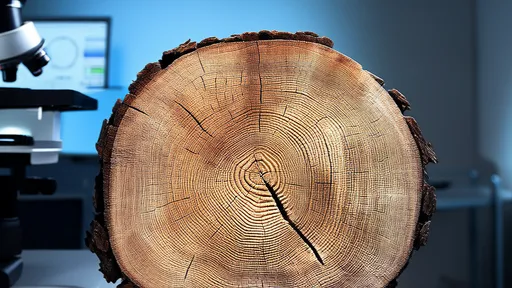
In the quiet stillness of ancient forests, trees hold secrets etched into their very fibers—secrets that scientists are now learning to decipher. The study of tree ring cellulose isotopes has emerged as a groundbreaking method to reconstruct past climate conditions, particularly drought patterns. Unlike traditional dendrochronology, which relies on ring width, isotopic analysis delves deeper into the biochemical fingerprints left by environmental stress. This technique is rewriting our understanding of historical climate variability with unprecedented precision.
At the heart of this research lies a simple yet profound truth: trees are meticulous archivists. As they grow, their cellulose incorporates stable isotopes of oxygen (δ¹⁸O) and carbon (δ¹³C) in ratios that reflect ambient conditions. During droughts, trees close stomata to conserve water, altering photosynthetic pathways and leaving distinct isotopic signatures. What makes this discovery revolutionary is its ability to distinguish between temperature-driven and precipitation-driven stress—a nuance traditional ring-width studies often miss.
The process begins with extracting cellulose from individual tree rings—each representing a single growth year. Using mass spectrometry, researchers measure isotopic fractions with extraordinary accuracy. In arid regions like the American Southwest, where drought recurrence intervals remain poorly understood, this method has revealed multi-decadal "megadroughts" that shaped pre-Columbian civilizations. One study of Colorado Plateau bristlecone pines uncovered a 50-year drought in the 12th century that coincided with the collapse of the Ancestral Puebloans.
Beyond archaeology, these arboreal records are proving vital for climate modeling. The European Space Agency's Earth observation programs now incorporate isotopic dendro-data to validate satellite-derived soil moisture indices. This synergy between ground truth and orbital sensors is improving drought prediction models, particularly for the Mediterranean basin where recent isotopic studies show intensifying aridity beyond anything seen in 900 years.
Challenges persist in standardizing methodologies across species and sites. A 2023 meta-analysis in Nature Geoscience highlighted discrepancies in isotopic fractionation between conifers and deciduous trees—a critical consideration when building hemispheric climate reconstructions. Yet the technique's potential is undeniable: researchers recently used Tasmanian huon pine isotopes to reconstruct Southern Hemisphere jet stream variability back to the 15th century, revealing previously unknown links between atmospheric circulation and megadroughts.
As climate change accelerates, these woody time capsules take on new urgency. The 2021 IPCC report incorporated isotopic tree-ring data for the first time in its paleoclimate chapter, recognizing their value in contextualizing modern extremes. In California's Sierra Nevada, scientists are comparing isotopic signatures from giant sequoias with instrumental records to quantify the unprecedented nature of recent droughts. Their preliminary findings suggest the 2012-2016 drought was the most severe in 1,200 years—a sobering insight hidden within cellulose molecules.
The future of this field lies in integration. By combining isotopic data with other proxies like lake sediments and ice cores, researchers are building 4D climate models that capture both spatial and temporal variability. A pioneering project in Scandinavia is cross-referencing Viking-era oak isotopes with Norse sagas, creating what historians call "environmental-textual forensics." Meanwhile, advances in laser ablation mass spectrometry now allow sub-annual resolution, enabling scientists to track individual dry spells within a single growing season.
For policymakers, these insights arrive not a moment too soon. Water resource managers in the Colorado River Basin are using millennium-long isotopic drought atlases to stress-test allocation plans. The World Bank's recent investment in pan-tropical tree isotope networks aims to improve monsoon predictions for agriculture. As one researcher quipped while coring a 800-year-old Mongolian larch, "We're not just reading tree rings—we're translating a language the Earth has been speaking for millennia."
What began as academic curiosity about woody biochemistry has blossomed into one of climatology's most versatile tools. From validating medieval chronicles to informing 21st-century infrastructure projects, isotopic dendrochronology proves that sometimes, the most sophisticated data storage system isn't silicon-based—it's cellulose-based, and it's been growing quietly in our forests all along.

By /Jul 18, 2025

By /Jul 18, 2025

By /Jul 18, 2025

By /Jul 18, 2025

By /Jul 18, 2025

By /Jul 18, 2025

By /Jul 18, 2025

By /Jul 18, 2025
By /Jul 18, 2025

By /Jul 18, 2025

By /Jul 18, 2025

By /Jul 18, 2025

By /Jul 18, 2025

By /Jul 18, 2025

By /Jul 18, 2025
By /Jul 18, 2025

By /Jul 18, 2025
By /Jul 18, 2025
